The myth of frictionless efficiency
When you run into a question about an unfamiliar topic, hit a wall on a concept, or need to sanity-check a half-formed thought, what do you actually do first?
Over the past couple of years, the answer for most people in creative and knowledge work has quietly changed. Instead of turning around in your chair, waiting for a colleague to finish a phone call, or sending a quick message on Slack, the default impulse is to open a prompt window.
It is easy to see why. Querying a model gives you a coherent, nicely structured answer in about three seconds. It spares someone else an interruption, avoids the friction of coordinating calendars, and protects you from the mild vulnerability of having to admit you do not know something.
Yet beneath that quiet convenience lies an uncomfortable trade-off: skipping those messy, informal chats cuts out healthy debate, the very friction and disagreement that historically turns half-baked thoughts into great ideas.
When we replace a conversation with a colleague with a session in front of an algorithm, we miss the unplanned pushback, the institutional memory, and the perspective that only another human with real context can offer. What feels like personal efficiency in the moment quietly flattens the collective depth of our work.
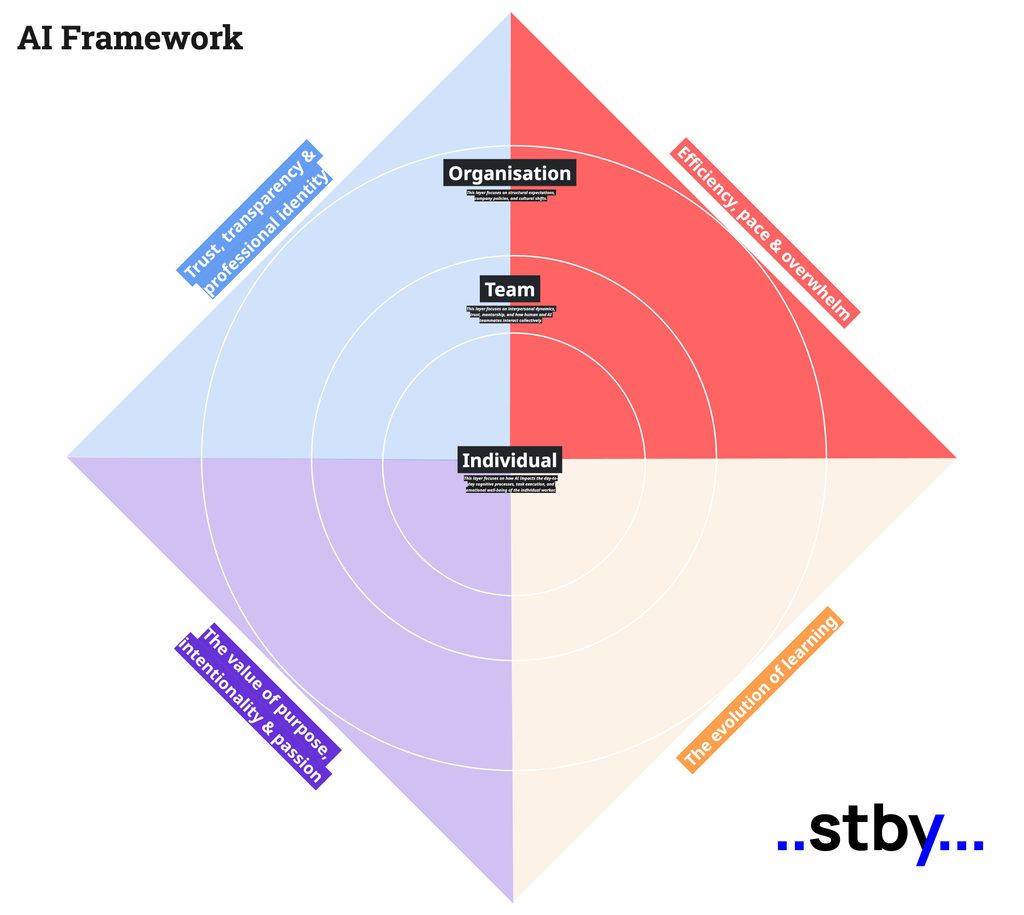
This tension forms the heart of the first quadrant in our Teaming with AI Framework: Efficiency, Pace & Overwhelm. At its core, this examines the paradox of technological acceleration: the very tools promised to save us time often end up distorting how we spend it. When generating work becomes virtually instantaneous, the messy friction of human collaboration, the pauses, the desk-side questions, the healthy disagreements, is easily mistaken for inefficiency and quietly engineered out.
What replaces it is a relentless, unchecked pace. Across our research, we see this playing out as an inverted bottleneck: while individual drafting accelerates, the cognitive burden simply shifts downstream into exhausting cycles of quality control, verification, and fact-checking. Rather than liberating headspace for creative contemplation, speed frequently rushes people into premature solutions, floods teams with unvetted artefacts, and isolates colleagues in solo prompt windows. Far from effortless efficiency, it creates a subtle, persistent overwhelm that risks burning people out while flattening the quality of the work itself.
Two years of listening to what actually happens
This piece opens a four-part series looking at the human and cultural realities of working alongside artificial intelligence, rather than the marketing promises. The framework itself is drawn from more than two years of ethnographic and participatory research led by Stby alongside our research partners:
- The Longitudinal AI Diary Study (Rounds 1 & 2): Run in partnership with the global Teaming with AI community, following creative practitioners, design leaders, technologists, and educators over extended periods to document the daily friction, doubts, and small adaptations of living with generative tools.
- AI and the Future of Work: Qualitative research carried out across the UK workforce with the Tony Blair Institute for Global Change (TBI), exploring the lived experiences of employees across three concentric rings: Your Work (Individual), Your Work Environment (Team), and Your Job Role (Organisation). This discovery research formed the empirical qualitative foundation for the Workplace Experience chapter in TBI’s report, The Impact of AI on the Labour Market.
- Organisation-Wide Learning and Experimenting with AI): An engagement with a large Dutch management consultancy, working directly with frontline practitioners and leadership to explore how an organisation can learn through practical experimentation without drowning in additional workload.
Across all three studies, the clearest lesson was that efficiency is rarely straightforward. When we accelerate tasks in isolation, we do not simply remove drudgery; we introduce hidden social costs, create bottlenecks elsewhere, and generate new kinds of fatigue.
To make sense of where pace and overwhelm genuinely bite, we have to look across three layers where work actually happens: individual, team and organisation.
Layer 1: The individual (your work)
At a personal level, using generative tools often starts with an unmistakable hit of relief: drafting an awkward email takes seconds, meeting notes summarise themselves, and early visual options appear at the click of a button. But as people settle into daily use, that initial speed reveals sharper edges.
- Rushing into answers before understanding the question: Generative design tools make producing polished solutions so effortless that teams often rush to answers without properly framing the problem.
- The loss of natural stopping points: By eliminating natural creative pauses, AI tools encourage endless iteration that can lead to decision fatigue and erode the creator’s personal voice.
- Creeping dependency and validation anxiety: Over-relying on AI tools can erode personal confidence, turning productivity shortcuts into a habit and need to validate everything with AI.
- Degrading reading skills undermine independent judgment: Outsourcing deep reading and synthesis to AI can blunt critical thinking and erode our intuition.
Layer 2: The team (your work environment)
No one works in a vacuum. When individuals start accelerating their own work in private, the ripples immediately hit their team.
- The hidden social cost of solo working: Most generative tools today are built around an isolated setup: “one brain, one bot”. You sit alone with an open tab, prompting a model in private. But as we noted in our discussions with design managers, there is a very real social cost here: every hour you spend in a closed dialogue with an AI is an hour you did not spend bantering, debating, or solving problems with your teammates. Over months, that quiet withdrawal chips away at team culture, collective empathy, and shared context.
- Artefact inflation and fragmented direction: Because individuals can now produce dozens of layouts, pitch decks, or variations in an afternoon, teams find themselves drowning in their own output. Instead of helping everyone align, having twenty distinct, fully mocked-up directions on a virtual whiteboard makes reaching a consensus far harder. The team ends up spending its meeting time wading through artifact inflation rather than coalescing around a shared idea.
- The inverted bottleneck: moving the headache downstream: Organisational leaders frequently assume that if individual drafting is five times faster, the team will produce five times as much work. What actually happens is an inverted bottleneck. The speed of drafting at the front of a project dumps an overwhelming burden of quality control onto managers and senior peers downstream.
- Senior practitioners find themselves spending hours fact-checking synthetic outputs, weeding out hallucinations, and untangling subtle logical errors. As a design lead in our diary study observed, when juniors generate UI layouts or code with AI, they often cannot explain why a particular decision was made because they did not build it from the ground up. Reviewing the work becomes more exhausting and time-consuming than doing it manually from scratch.
- Distorting the junior-senior dynamic: When junior team members use AI to answer every basic technical query, senior staff get fewer interruptions, which feels like a relief in the short term. But it breaks the tacit apprenticeship that creative careers depend on [TwAI diary study round 2]. Juniors move ahead with AI-generated plans that lack strategic intent, while seniors lose the informal touchpoints where they used to pass down judgment, ethics, and craft.
Layer 3: The organisation (your job role)
When these tensions reach the wider organisation, executive expectations about efficiency run directly into operational reality.
- The commercial squeeze on hourly workers: In our ethnographic research for the Tony Blair Institute across the UK workforce, we saw clearly that efficiency gains do not land equally. For freelancers, contractors, and hourly workers, increased tool speed often results in a penalty. Clients and managers begin expecting higher volumes of polished deliverables within the same billable window, with no increase in pay. The assumption of instant generation creates an unspoken expectation to squeeze more output into every contracted hour.
- Workload resistance in overstretched teams: In our work with Berenschot, we saw that people who are already run off their feet with client deadlines do not greet new AI tools with open arms. If an organisation simply announces AI as “another piece of software on your laptop” without taking anything off people’s plates, staff push back. Shifting from a hands-on “doer” to an “orchestrator” sounds neat in an executive slide deck, but without dedicated time to experiment and adjust, it feels like unpaid administrative overhead.
- Being managed by algorithms: In organisations where AI tools are plugged directly into task allocation, ticket routing, or project intake, workers report a subtle, unsettling sense of alienation. Having an AI agent assign you tasks or triage client briefs without human context leaves people feeling like cogs in an automated machine rather than trusted professionals.
- The illusion of instant strategic thinking: Clients and internal stakeholders are starting to expect rapid turnaround on technical deliverables: meeting transcripts, initial wireframes, or rough prototypes in hours rather than days. But as Vincenzo, an agency leader in our diary study, pointed out, deep problem-solving cannot be hurried. His studio intentionally turned down a lucrative partnership with a tech startup because the startup wanted to churn out website designs after a single meeting, directly clashing with the slow, considered, organic design process his clients actually needed.
Where Do We Go from Here?
Coping with pace and avoiding overwhelm is not about banning tools or pretending they do not exist. It is about building conscious, deliberate habits across all three layers of the organisation. At all three levels, you can take action:
- At the Individual Level: Practise Intentional Non-Use: Members of a team should reflect on and recognise the modes they currently use. Know when to keep the laptop closed. Choose deliberately to sketch on paper, read a complex brief without an AI summariser, or write a rough first draft entirely in your own voice. Setting personal boundaries on iteration is the only way to protect your creative stamina.
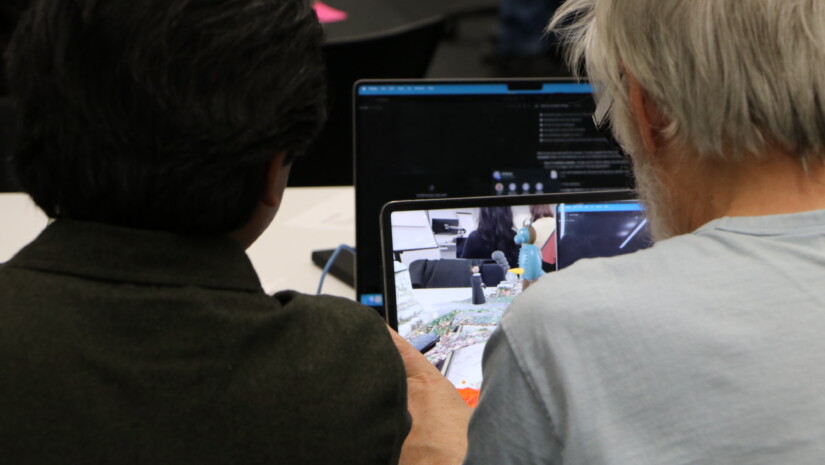
- At the Team Level: Break the Solo Loop: Teams must help individuals communicate and adjust realistic expectations on each other’s performance/speed/quality of work. Shift some of your AI use out of private chats and into shared rooms. Experiment with “many brains, one bot”, gathering three or four colleagues around a single display to co-prompt, interrogate the answers, and pick them apart together. Crucially, make it safe for people to ask each other “stupid” questions again, protecting the conversations that build trust and sharpen thinking.
- At the Organisational Level: Measure Full Lifecycles, Not Asset Counts: Stop evaluating productivity by how many slides, wireframes, or documents an individual can generate in a week. Recognise the real human cost of downstream quality control, and protect freelancers and hourly staff from uncompensated pace creep. If you want people to learn, give them genuine space to experiment rather than layering new expectations over an already full workload.
Framework
Next in the Series
When people lean on algorithms for fast answers in private, what happens to the way we learn our craft, mentor junior colleagues, and develop genuine domain expertise over time?
In Part 2, we will explore the second quadrant of the framework: The Evolution of Learning. We will look at the breakdown of traditional apprenticeships, the risk of cognitive atrophy, and how junior practitioners are redefining their roles as exploratory innovation catalysts.