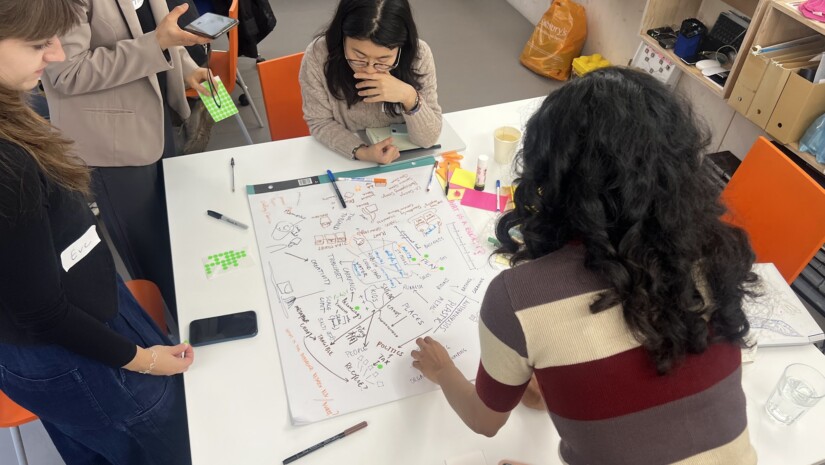
Recently, our London studio was buzzing with energy as we hosted the London Gov Jam. While this event is always a whirlwind of service design and community collaboration, this edition offered us a particularly sharp lens into a topic we’ve been exploring deeply: the evolution of AI from a productivity tool to an active collaborator in creative teamwork.
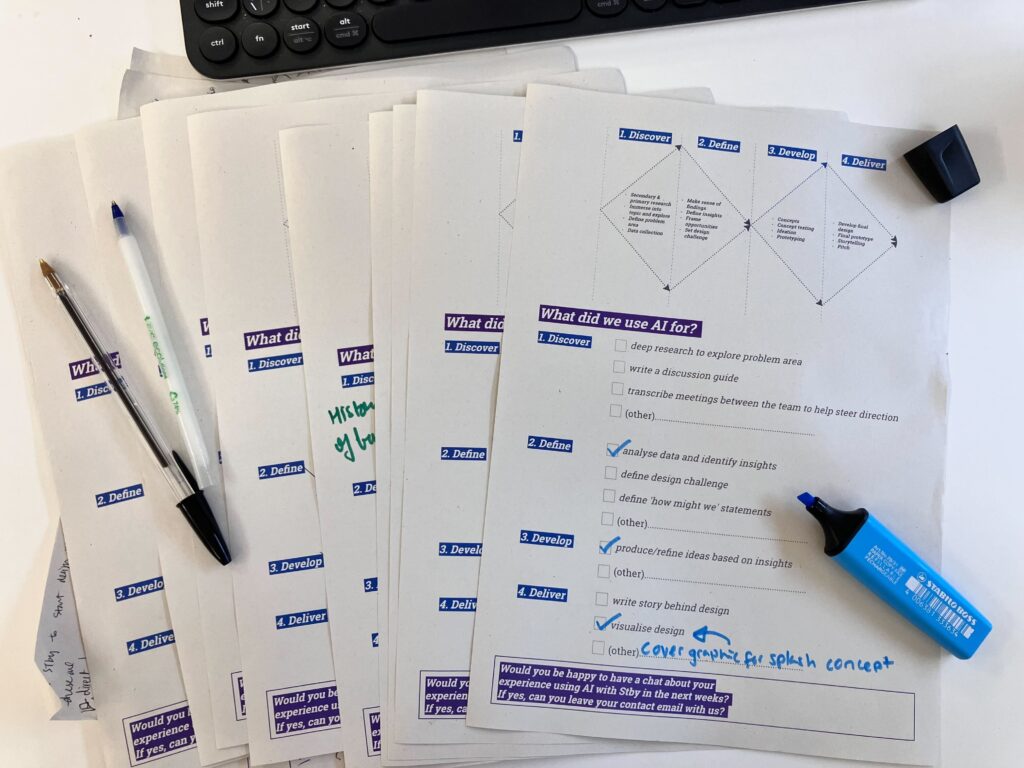
During the jam, we asked teams to consider the use of AI at every step of their journey. Through surveys and direct observation, we tracked how human-to-human collaboration shifted when a digital agent was added to the mix. What we found wasn’t just a change in efficiency, but a fundamental shift in team dynamics, confidence, and depth. By analysing how different teams navigated the process, we identified three core tensions in this rapid AI-human design process.
The Extra Teammate
Most teams shifted between human-only and human-AI collaboration with non-explicit decision points, often basing the switch on individual intuition. AI is brought in almost as a member of the team, but for different purposes.
One team used ChatGPT as an impartial teammate to bridge disagreements. When the teammates could not agree with each other, they used ChatGPT to do research on the topic together to see if this impartial teammate could shed new light on the argument for them. By throwing problem statements at an AI agent, teams quickly visualised a range of scenarios that helped them find common ground. However, on reflection, one of the team admitted that this introduced a hidden risk: premature convergence. The ease of reaching consensus via AI tempted some jammers to skip the valuable, albeit messy, stage of diverging on ideas. As one jammer noted:
AI acts as a back-up when you don’t have a human to bounce ideas off, providing a useful starting point that helps a team pivot when the path forward feels fuzzy
The Confidence Gap
AI significantly influenced the internal power dynamics and confidence levels within the groups. We observed a distinct literacy divide in how teams approached the technology:
- The Equaliser: In teams where jammers were less experienced with service design but proficient with AI, they used the tool to level the playing field. One jammer used a custom GPT to decode UX terminology and frameworks in real-time, allowing them to participate in high-level discussions almost immediately.
- The Silent Barrier: Conversely, jammers with less AI experience often shied away from experimenting, leaving AI-confident members to decide when and how the technology should be consulted.
This suggests that while AI can be a powerful tool for inclusion, it can also create new hierarchies based on technical fluency.
The Speed to Polish Trap
The final tension involved the transition from ideation to prototyping. We noticed a recurring “speed to polish trap”: AI can produce a finished-looking artefact so quickly that it actually distracts the team from the value of low-fidelity testing.
One team used AI to rapidly generate summary slides and refined mock-ups in just a few hours. While the speed was impressive, it raised a critical question: When does refinement become a distraction? Some jammers felt that perfecting AI outputs kept them glued to their screens when the real value was waiting outside on the street through human-to-human interaction.
There is a fine line between a prototype being good enough to present a believable idea and rough enough to invite honest feedback. AI does not naturally generate rough content; its bias toward polished, confident outputs can lead teams down a rabbit hole of seeking comfort in aesthetic perfection.
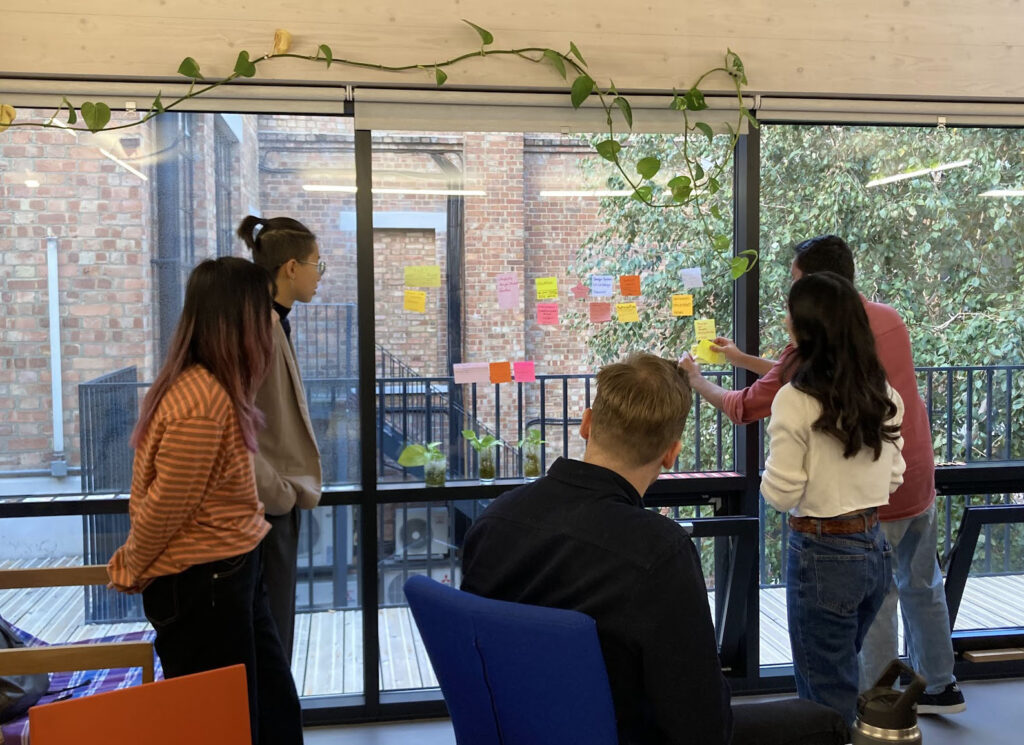
Maintaining the Raw and Human
For us at Stby, these reflections reinforced that AI is not a neutral tool of efficiency; it is a new element in team dynamics.
While it can empower designers and non-designers to contribute with newfound confidence, we must be careful that it doesn’t replace the essential, unpolished conversations that happen during the conversation and sketching process. Our challenge moving forward is to use AI’s speed to get us to the testing bed faster, rather than using its polish as an excuse to stay inside.
We are excited to keep testing how we can use AI to complement human intuition without losing the raw and human insights that define our work.
By Qin Han