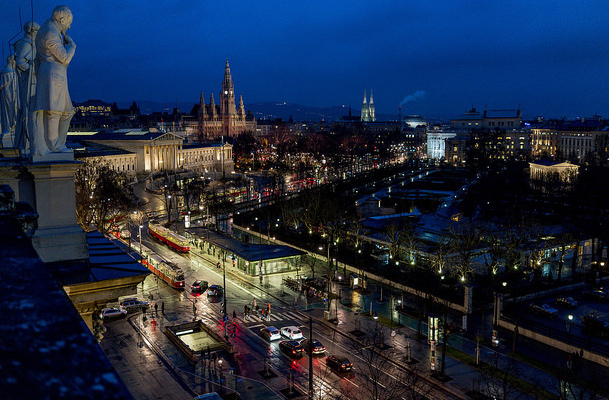
Cities are like organisms

Healthy organisms adapt and evolve based on what is happening in the world around them. Cities are ever-changing organisms, and part of their evolution and adaptation are the large-scale services they offer to their citizens. Because these services are so important for the quality of our lives, it is important to look at cities that provide them admirably well.

An exemplary organism

Though long overlooked as a European tourist destination, Vienna, Austria “…has ranked top in the last seven published rankings,” said Mercer after releasing their 2016 Quality of Living Survey. “It scores highly in a number of categories; it provides a safe and stable environment to live in, a high level of public utilities and transport facilities, and good recreational facilities.”

Vienna’s housing is uniquely affordable among major cities due to a long tradition of investing…

Living services

Through screens and interfaces, the distinction between human and machine is blurring. Already, a great deal more objects than people are connected to the internet, with more connecting every day. The digitization of everything leaves us asking one fundamental question: where do humans fit into the picture?

Design and innovation consultancy Fjord has partially addressed this question by coining the term Living Services. This concept merges the Internet of Things with what they call Liquid Consumer Expectations. The basic idea is quite simple: when customers (humans) have a positive experience in one industry, they carry the expectations from that experience into other industries.

For example, if a customer has a positive experience getting out of a taxi without having to go through a payment process (because it’s all happened in the cloud), this experience…

The Art Experience

Imagine the following scenarios:

You are in the Rijksmuseum early in the morning before opening hours. It’s quiet. You are standing alone in front of Rembrandt’s Night Watch in a spacious gallery, other master works behind you and to your left and right.

You are sitting in a café with a friend. Music is playing. You are flipping through a travel guide of Amsterdam, where you come across a picture of Rembrandt’s Night Watch between a photo of the Red Light District and a picture of Van Gogh’sSunflowers, all surrounded by text.

In each scenario, how do you experience the painting?

When we look at art, most of our attention is focussed on the artwork on display. Rarely will we pay the same amount of attention to the display itself: the context. The moment we begin to understand the relationship between art and its context, a whole new world opens up.

In 1972, …

Service Design is Everywhere

It’s surprising how our behaviour, while interacting with something we know very well, has changed by the influence of an investment in service design. A fantastic example of this is the library. It is a place that has been traditionally known for “shushing” people, requiring heaping mounds of paperwork in order to benefit from their services, penalizing slow readers with fines, and being staffed with busy and sometimes intimidating people.

Hushed to hospitable

If you’ve visited a library recently, perhaps you sensed something different going on. Most libraries have recognised that they no longer have a product; they are all about an experience. Currently, they are not in the business of books but the business of learning. They are working to understand the learning needs of communities and how to translate those needs into service and experiences…

Book club: How to thrive in the next economy

For the Strategic Creativity Book Club, we read How to Thrive in the Next Economy by John Thackara. The former director of the Netherlands Design Institute and the Doors of Perception events of the 1990s is a foundational thinker who has helped designers understand that design could – must – do more than only support narcissistic consumption. In this book, he tackles the question of whether and how we can reform to stop the ecocide of our planet.

The book is full of examples of transformative practices which might bring this about. Is some better way possible? We try to imagine what it might be, but can’t, because we can only think in terms of what we know. Another paradox: we must think much more broadly and systemically than ever before, while acting in mainly local, small-scale ways.

We emerge with mixed feelings. On the one hand, eliminating 95% of our energy consumption…

Design and the city: tabletop prototyping

In a workshop at the ‘Design and the City’ conference, participants focused on solving the problem of bicycle parking in the city. Bike parking in Amsterdam is now a tough problem. There’s basically no more room for the nearly million bikes that more than half the population uses daily to commute. In one year alone, 73000 illegally parked bikes were impounded, a costly situation for all involved. After presenting STBY’s research for Dutch Rail on this problem, we facilitated a workshop exploring future solutions.

The workshop took a tabletop design approach. Participants chose from among four goals, and were given a map, ‘user cards’ with specific profiles, cards with a location, and a few prototypical elements including a bike and a house. They made the rest as they went. They were asked to create scenario’s for 2020 or 2040, and to elaborate on one idea or concept.

It was interesting…

Internet of Things: where are the people?

Attending several IoT events, such as ‘IoT Tech Expo’, ‘IoT UK Thematic Research Day’ and ‘The future of IoT networks’, left me with the persistent feeling that the conversation around IoT is primarily about Things. More precisely: about connecting Things to Things, and connecting the connected Things to money. Exactly how human beings fit into this picture of a fast-unfolding Fourth Industrial Revolution often remains unclear, despite intense interest in questions as regards to ‘monetization’.

I wondered: where are the people in this picture?

Was it my own bias? Being a people-focused researcher, I would say that tech and monetization seem too dominant. And after a few events, I was sure: the talk is mainly about infrastructure and overcoming technical barriers. If value is discussed, it’s used to mean the cost of moving a bit of data from one device to another. Not social…

How do people close to us see STBY?

An interview with the partner of one of our design researchers.

It is sometimes hard to explain what we do – especially to people who are less familiar with our field of work than we are. To get a better sense of alternative ways to explain what we do, we asked some people close to us how they see us.

For this article we interviewed Thijs about his girlfriend Marie, design researcher at STBY Amsterdam.

How would you explain what Marie does?

When Thijs tries to explain to his friends exactly what his girlfriend does, he usually starts by telling them she is a researcher at STBY. “She’s not a typical market-researcher, but she researches how services of companies are being used.” Because it is difficult to understand what service design actually is, he usually tells his friends that she tries to figure out how services can be improved by investigating the behavior …

How to thrive in the next economy

For the third time STBY will be organising the Strategic Creativity Book Club. This is the idea: read a book and join us in the Spring House library to enjoy the ongoing discussion on the strategic role of designers in creating change in society and the economy. We’ve done this twice since we’re housed in Spring House and we enjoyed it a lot, so we are organising another one – and you are most welcome to join us on April 11th! 

For this session we are featuring the book ‘How to thrive in the next economy’ by John Thackara. The book reads like a collage of examples of how communities around the world not only think and talk about change, but also act to design a more sustainable future. It is about using the small to change the big in a meaningful way. The book makes you pessimistic about the state we are currently in, but optimistic about all the small examples that have the…

Prototyping helps organisations forward

Many innovative companies can struggle with a ‘meeting culture’ where everyone has a say – it can lead to slow processes with little progress. There is always someone who sees a problem which has to be solved before implementing something; this can be very frustrating and paralyses organisations.

Prototyping can push organisations forward. A prototype is a draft of a product or service that allows you to explore your ideas and demonstrate your intentions to users before investing time and money in development. A prototype can range from a low-fidelity paper drawing to a high-fidelity functioning mockup.

Prototyping can be seen as a surrogate for a future situation, giving you the ability to gain knowledge about the future situation, how the new product or service may be used. It is an effective way of doing, making, and trying, receiving feedback from users, developers,…

Workshop ‘Ideation Techniques’ March 29

On 29 March 2016, the Dutch chapter of the Service Design Network, of which STBY is one of the active core members, is organising an evening around Ideation techniques.

As service design enthousiasts we use many tools and techniques to create useful and meaningful services. How do you stretch yourself to think in new ways? Do you have tips and tricks to share? And what can you learn from others? This is what will be discussed in this workout. Maartje van Hardeveld (UX team coordinator at Rabobank, and a very experienced facilitator) will show how she gets the most out of her ideation sessions.

To put this newly gained knowledge into practice we have a very exciting topic to work on. The Service Design Network is bringing the 9th Service Design Global Conference to the Netherlands! As the Dutch chapter of the SDN network we will welcome many international Service Designers to Amsterdam.…