Rigorous documentation: A research superpower

When research activities get going in earnest, a lot is produced. If treated too casually, the mass of audio files and transcripts, flip-overs and mini-posters full of post-its, photos, interview notes and feedback mails can quickly turn into a massive hairball that no-one can unpick.

Where do people fit into the Internet of Things?

There are now more things connected to the internet than the number of people in the world. Many of these devices are inside our home, from Bluetooth speakers to smart coffee machines and fridges. In the future, even our plates and curtains might be hooked up to the internet. The house will then resemble a lab, in which we are the studied subjects. How much alcohol do we drink? How often do we wash our hair, or cut our nails? Are we snacking more than usual? Spending longer in front of the mirror? Maybe the homes of the future will know.

MozFest workshop: Connecting citizens, not only devices

What is a city without its people? Not much. But sometimes, in all the technology talk around cities, the focus on people gets lost. How can we foster a citizen-led approach to smart city development, and how might that change how smart cities are defined and realised?

That was the question we posed during another walking workshop we were recently invited to conduct, this time in the context of the open Internet movement. MozFest, Mozilla’s annual festival, returned to London to host an international community of educators, technologists, artists, journalists and activists, as well as anyone else engaged with the challenges arising within online privacy, web literacy, and the realisation of a healthy, open Internet.

In our ‘walkshop’, we wanted to explore the future of the connected, online city. Specifically, we wanted to explore and champion a bottom-up, emergent city…

Designing for predictive public spaces

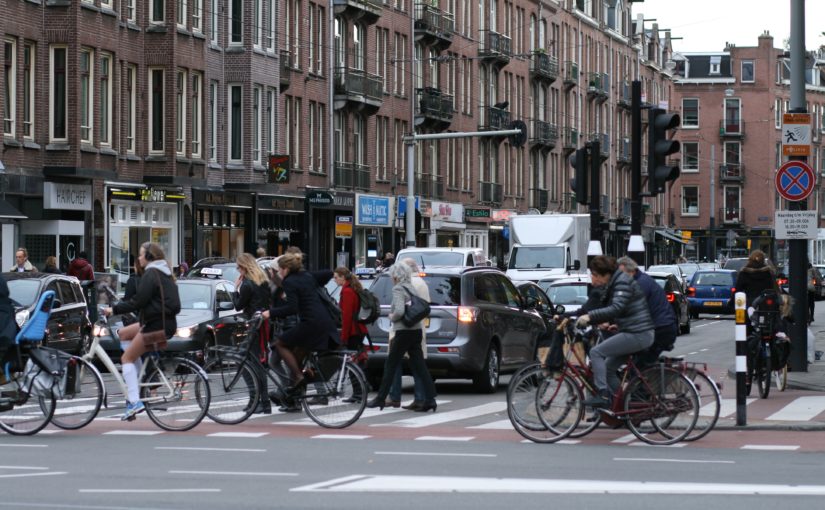
While working on a series of projects aimed at improving the experience of pedestrians and bicyclists, I was reading Andy Clark’s book Surfing Uncertainty: Prediction, Action and the Embodied Mind. This proved an unusually fruitful combination, even though the book is about perception, not about design. But in the context of these design problems, Clark’s explanations became interesting points of departure which often reshaped my perspective.

His phrase: ‘a web of humans and machines, each of which are now busily anticipating the other’ seems to me a perfect description of what our busiest urban public spaces are becoming. As ‘smart’ systems become more prevalent, physical touchpoints are being minimised or disappearing altogether, from whole cashier-operated checkout counters to familiar everyday features like taps, handles…