
Future Focused Gen Z Co-Creation
Young people’s behaviour has become a driving force in influencing how brands shape the future of Product Service Systems (PSS). Gen Z is the first generation that is truly digitally native; and as global connectivity rises, they have taken an important role in driving how businesses and organisations interact with people. For this reason, we are seeing more of our clients becoming increasingly interested in understanding this generation, as they recognise their role in behaviour change and societal impact.
Approaching projects involving Gen Z participants
We worked with a client who was interested in involving Gen Z participants in the development of their future digital services. Involving participants aged between 11–26 in co-creation requires careful consideration of approach and methodology to cater to their specific needs and mindset. At the time of this project, young people’s lives had been disrupted considerably, perhaps more than most people’s lives. Their habits and needs had changed in relation to other people of this age group previously, mostly due to COVID-19 but also as a result of rapidly evolving digital media usage. ‘Zillennials’ were forced to find new ways of making friends and relationships, which created tensions, and even a certain antipathy to connecting online. However, this generation also seems to be more acutely aware of the fact they are part of a global community that is facing worldwide problems. This shift in mindset towards digital connectivity and human interactions was something we had to carefully consider in our research approach, to collaborate with these young people and reach the full potential of this research project.
Here are some examples of how we approached co-creation with Gen Z participants:
Advantages to recruiting Gen Z participants in pairs
During recruitment, we asked participants to bring along a friend. The main reason for this was to help create a more comfortable experience for them. It gave them someone to consult with and make them feel like they were not alone in the process. For example NDAs, these can be seen as a burden and something not all participants are used to doing. Having someone who can talk about this can make the experience less daunting. Similarly, participants had a friend to discuss pre and post-work as part of the research study, which took the pressure off from doing these activities, and led to better results with a more relaxed participant.
Creating a comfortable environment for open discussion between participants:
Co-creation sessions are a great opportunity to introduce new perspectives to an idea or process. In order for this to happen effectively, participants must feel comfortable sharing their honest opinions with the rest of the group. In this specific project example, there were participants aged between 11-26, which may prevent participants from discussing certain topics or points of view due to the difference in ages and life experience. In order to create an environment where all participants felt comfortable having open conversations, the sessions were structured to include 2-3 pairs of similar age groups. This created a safe space, as each participant recognised that the rest of the group are more likely to have empathy for their experiences and challenges.
Carefully considering the age groups within the co-creation session resulted in engaging discussion, eventually leading to design recommendations that were genuinely accommodating to the needs of the specific age groups.
4 steps of this project’s co-creation
This project was structured to have multiple stages of co-creative dialogues between the client and the participant. This helped create an exciting experience for the participants, as they could see their creative contributions having an impact on the iterative process. Here are the 4 steps of co-creation that were used before, during, and after the online workshops with Gen Z participants.
1. Creating concept cards
Together with the client we prepared some concepts depicted on cards with possible future elements of the PSS, around topics such as identity and community.
2. Prioritising features
The participants priotitised and discussed the features that appealed to them most and why. With these, they built a future PSS and describes it in words and images, all in an online co-creation workshop.
3. Producing concept films
The client team then developed the concepts in response to the participants’ feedback and produced some digital prototypes to bring these to life. Participants were presented with some short explainer videos to help depict the possible future PSS that they had helped envision. This was highly engaging for the young participants, as it made them feel that they were truly involved in the iterative process and that their creative input had been valued.
4. Responding to the concept films
The participants all provided responses to these videos via videoask.com, giving their feedback via selfie videos.
As well as creating an engaging experience for the young participants, providing multiple points of interaction also considerably benefits the client stakeholders. This process allows for several opportunities for concept iteration, development and refinement; as a result, the output was highly validated and the design team had a lot of confidence in the outcome.
Tailoring project delivery for different client teams and levels
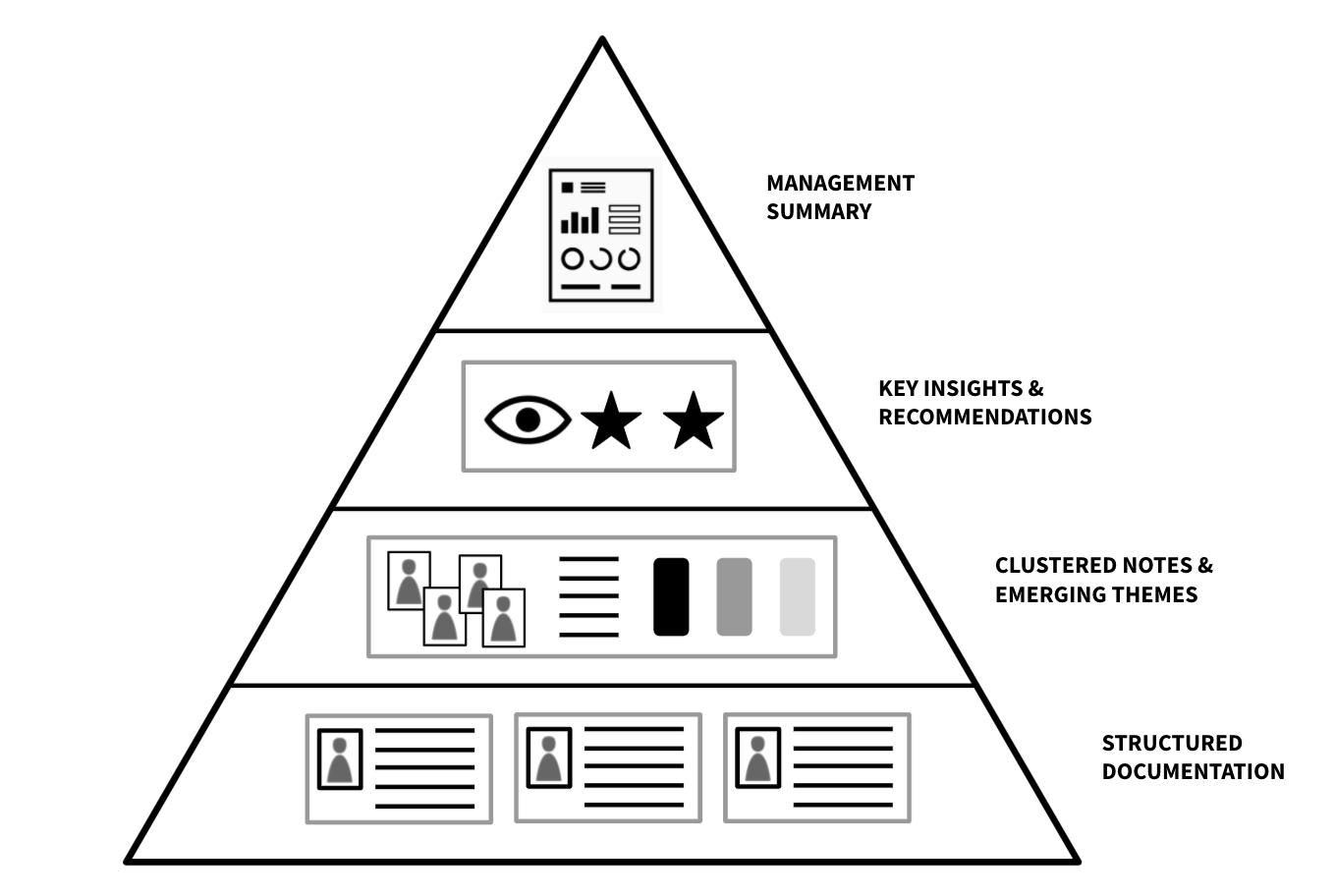
It was important to consider the format of this project output carefully, as different client teams were required to work with the results. To ensure that the research outcomes were actionable, insights and findings were presented to different client teams in appropriate levels of detail. We delivered a large repository with an extensive report that the in-house researchers could use to create internal reports, which were tailored to different internal teams at different levels. STBY’s Pyramid of Deliverables is a framework we use to help structure our project output (see diagram).
It was crucial that the design recommendations were supported with a written report, as well as a deck of insights and recommendations. It was required to have well-structured feedback documentation and clear stories and creations from Gen Z participants. Access to documentation for each participant was key; per market, per theme, and per concept within the overall sample. This was to ensure the client team could go back to data at the individual level and to access key quotes and relevant visual documentation when needed. Powerful and inspiring visual material was also delivered to help engage a wide range of stakeholders.
Each stage in the project is documented in a structured way, to enable tracing back from the conclusions and recommendations to the original data. This is to ensure the validity of the outcomes, as well as to offer opportunities for interested stakeholders to dive deeper in the underlying data set for further information and inspiration.